EIFS can look flawless for years, right up until a hailstorm sweeps across Edmonton and leaves pockmarks, hairline cracks, and wet spots that do not dry. Homeowners often ask if EIFS is repairable or if a full replacement is unavoidable. The short answer: most EIFS damage can be repaired, and a skilled crew can blend the finish so the fix is hard to spot. The longer answer depends on what caused the damage, how much moisture got in, and how fast the issue is addressed.
This article lays out what can be repaired, what should be rebuilt, realistic costs in the Edmonton market, and how Depend Exteriors approaches EIFS hail damage repair Edmonton homeowners can trust for longevity and curb appeal.
What EIFS Actually Is, and Why That Matters for Repairs
EIFS, or Exterior Insulation and Finish System, is a layered wall system. From inside to out, a typical configuration includes sheathing, a weather-resistive barrier, adhesive or mechanical fasteners, an insulation board (often expanded polystyrene), a base coat with embedded fiberglass mesh, and a colored acrylic finish coat. On well-detailed systems, you will also see back-wrapping at terminations, proper flashing around windows and doors, and expansion joints between dissimilar materials.
Repairs must respect those layers. If a repair only addresses the finish coat while ignoring cracked mesh or a saturated insulation board, the problem returns. A proper fix reconstructs the damaged layers and reconnects them to adjacent, sound materials. That is why a walk-around inspection and moisture mapping matter before any patching.
Common EIFS Problems Seen in Edmonton
Storms in Edmonton can be harsh, and temperature swings are significant. Freeze-thaw cycles, wind-driven rain, and hail create specific failure patterns. Based on local projects, the most frequent issues include small impact craters from hail, spider cracking around window corners, delamination of the finish coat from UV and age, punctures from ladders or shovels, and moisture intrusion at poor terminations or missing kick-out flashing.
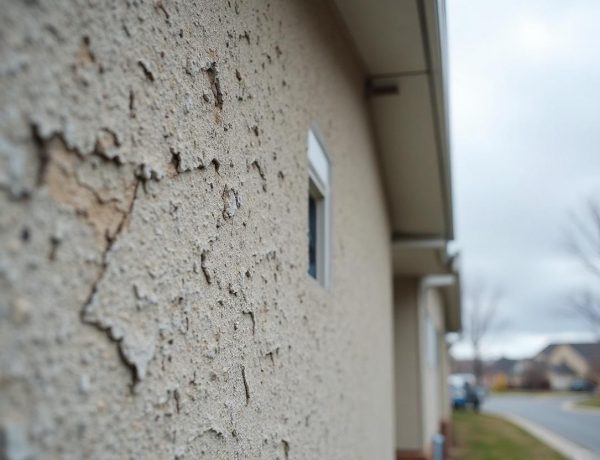
The presence of hail damage is the most urgent because it often hits wide areas. Tiny craters in the finish coat may not look serious, but repeated impacts can fracture the base coat and mesh. If water enters through those fractures, insulation board can soak up moisture like a sponge, and wood sheathing can be at risk. The faster the evaluation, the less likely the repair turns into a rebuild.
Can EIFS Be Repaired? Yes—Here’s How Pros Do It
Purely cosmetic damage in the finish coat can be cleaned, patched, and refinished. Cracks that reach the base coat need mesh replacement in a widened area. If the insulation board compresses at impact points or crumbles, the compromised sections get cut out and rebuilt. Where flashing is missing or wrong, the system gets corrected so water leaves the wall instead of entering it.
For minor hail impact: a thin skim of compatible base coat over a bonded surface, embedded fiberglass mesh feathered past the damage, and a finish coat that matches texture and color. For deeper issues: removal to the sheathing, moisture readings, replacement of insulation board with back-wrapped edges, new base coat and mesh, then finish coat. Color matching is a skill; even factory-matched buckets can dry slightly different depending on sun exposure and age of the wall. An experienced crew blends edges or refinish-panels discretely to avoid a patchy look.
How to Tell If You Have EIFS Hail Damage
Small chips, pockmarks, and shallow divots are typical after a hail event. Standing back in angled light helps; hail marks show as dull spots where the finish coat scuffed. Run a hand gently across suspicious areas. A rougher feel or small pits usually equals impact. Around windows and door heads, look for hairline cracks. Inside the home, watch for drywall nail pops near exterior walls or musty smells after rain; these are red flags for moisture behind the cladding.
Depend Exteriors commonly finds the worst hail damage on south and west elevations in Edmonton neighborhoods like Windermere, Glenora, Summerside, Terwillegar, and Lewis Farms, where exposure is stronger. Detached garages also take a beating because they sit higher and get more direct hits.
Repair Versus Replacement: Making a Smart Call
Full replacement is rare on newer EIFS when the damage is localized and the original installation is sound. It becomes the right decision when moisture has spread widely, the system lacks proper flashing, or the EIFS is a face-sealed design from an older build that has leaked repeatedly. Partial replacement is often enough for a wall or elevation that took the brunt of the storm.
A practical decision flow helps. hail damage stucco repair Edmonton If impacts are superficial, repair the finish. If cracks run through the base coat, rebuild those sections with mesh. If moisture readings are high across a wide area, open test cuts to confirm sheathing condition and plan for panel replacement. Re-skinning one or two elevations can be cost-effective when matching color on a sun-faded house would look uneven or when insurance supports broader restoration.
Costs Homeowners in Edmonton Can Expect
Costs vary by access, elevation height, the presence of architectural features, and the number of test cuts. Typical ranges seen locally:
- Minor finish-only repairs after hail, on a single elevation with easy access: roughly $8 to $14 per square foot of affected area. Base coat and mesh repairs with texture and color blending: roughly $14 to $22 per square foot. Sectional removal and rebuild down to sheathing, including new insulation board, mesh, and finish: roughly $28 to $45 per square foot, higher if extensive moisture remediation is needed. Full elevation re-skin with new finish for color consistency: budget $18 to $30 per square foot depending on chosen texture and whether control joints or flashing upgrades are included.
Insurance often covers hail damage. Carriers usually ask for a detailed scope with photos, square footage, and a map of elevations. Depend Exteriors prepares those reports and meets adjusters on site to align on quantities and repair methods. That coordination helps avoid under-scoping, where only the most visible hits are counted while the rest of the elevation remains compromised.
What Makes EIFS Hail Damage Different From Stucco Damage
Traditional cement stucco is dense and rigid, while EIFS is lighter and more impact-sensitive. Hail that would bruise stucco can fracture EIFS mesh. EIFS also relies on the integrity of its finish coat and sealed penetrations to keep water out. Once hail breaches that skin, moisture can track laterally across the foam, then enter at seams or fasteners. Repairs must re-establish the mesh and finish system continuity. A simple caulk-and-paint approach fails on EIFS because it does not recreate the layered protection.
Real-World Example: Storm Repair in Southwest Edmonton
After a late-spring storm, a two-storey home in Ambleside showed scattered pocks on the west wall and deeper damage around a second-floor window. Moisture readings near the sill were high. Test cuts revealed cracked mesh and a wet insulation board over a two-square-metre area. The crew removed the wet section to sheathing, dried the substrate, installed new drainage mat on hail damage contractors Edmonton Depend Exteriors that panel, back-wrapped edges, and rebuilt the base coat with high-impact mesh near the opening. The finish coat on the full west elevation was resprayed to match the faded color. The homeowner’s claim covered elevation-wide finish, while the targeted rebuild addressed the water path. The repair is still performing five winters later.
Moisture: The Deciding Factor
Hail creates the opening; water does the damage. Before any finish patch, a pro checks for hidden moisture using capacitance meters and strategic test cuts. Symptoms that suggest deeper issues include bulging surfaces, persistent dark patches after rain, soft spots when pressed, or sealant joints pulling away. Ignoring moisture at the repair stage is the main reason EIFS issues reappear.
In Edmonton’s climate, freeze-thaw stress worsens trapped moisture. Wet foam expands and contracts, which breaks bond lines and enlarges cracks. A good repair starts by stopping water entry with correct flashing and sealing, then rebuilds the EIFS layers.
Color and Texture Matching That Does Not Look “Patched”
Acrylic finishes age and chalk slightly under UV. Even if a crew orders the same manufacturer, color code, and texture, the old wall and new patch can read differently in sun. Two strategies help. First, feather repairs larger than the visual damage to blend texture over a broader zone. Second, refinish to a break line such as a corner, control joint, or architectural band. For north-facing walls that see little sun, spot matches can be nearly invisible. For south and west faces, a broader blend or full elevation finish often looks cleaner.
Building Science Upgrades Worth Adding During Repair
A hail repair is a chance to correct weak details. Kick-out flashing where roofs meet walls stops water from pouring behind the cladding. Head and sill flashings above doors and windows direct water out and away. Back-wrapping the mesh around terminations protects edges from peeling and impact. High-impact mesh around garage doors and at grade-level corners resists future damage. Sealant selection matters; use manufacturer-approved sealants compatible with acrylic finishes and apply correct joint geometry. These small upgrades pay off in long-term durability.
Timing Matters After a Storm
Edmonton hail seasons tend to hit late spring to mid-summer. Contractors book fast, and early moisture can spread before crews arrive. A rapid assessment limits secondary damage. Temporary measures such as breathable protective coatings or weather-resistant tape over torn areas can hold the line for a short period, but they are not permanent solutions. Depend Exteriors typically prioritizes emergency stabilization first, with a detailed scope and schedule following within days.
How Depend Exteriors Handles EIFS Hail Damage Repair in Edmonton
Homeowners often want a simple, predictable process. The workflow used locally balances speed with thorough diagnostics.
- On-site assessment: inspection of all elevations, photos of impact patterns, and moisture readings around openings and suspect zones. Scope and estimate: line items for finish-only areas, base-and-mesh repairs, and any panel rebuilds, plus optional elevation-wide refinishing for uniform color. Insurance coordination: documented hail map, unit pricing, and adjuster walk-through. Repairs and upgrades: remove compromised sections, correct flashing, rebuild EIFS layers, and refinish to natural break points. Final check: adhesion tests on new finish, sealant review, and homeowner walkthrough with maintenance tips.
This method keeps surprises low and lets the homeowner choose between a minimal fix, a performance upgrade, or a visual refresh.
Maintenance That Extends EIFS Life
Simple habits reduce future risk. Keep sprinklers off the walls, trim shrubs so finishes can dry after rain, and avoid leaning ladders without padding. Clean dirt and algae with a gentle wash using manufacturer-approved cleaners. Inspect sealants annually, especially where EIFS meets windows, deck ledgers, and stone cladding. After any hail event, do a quick perimeter check within 24 to 48 hours. Early detection means easier, cheaper repairs.
Honest Limits: When Repair Is Not the Best Choice
There are cases where patching is false economy. If the sheathing is soft over large areas, if there is no functional weather-resistive barrier, or if multiple elevations show long-term staining and failed sealant joints, a comprehensive rebuild may be smarter. Homes with repeated previous patches that never addressed missing flashing often benefit from a fresh start on the affected elevation. A reputable contractor will explain both paths and the risks attached to each.
What Homeowners Should Ask Before Hiring
The right questions save time and cost. Ask whether the crew is trained on the specific EIFS brand on your home, whether they will perform moisture testing and provide photos, and how they match color and texture. Confirm that flashing corrections are included where needed, not treated as extras that get skipped. Finally, ask for references from recent Edmonton projects involving hail. Local experience matters because hail patterns, insurance norms, and weather windows differ from one city to another.
Why Local Expertise Matters in Edmonton
EIFS behaves differently across climates. Edmonton brings large temperature swings and fast freeze-thaw cycles. Materials need the right cure time and application temperatures. Crews must plan around weather to avoid cold joints and improper drying. Depend Exteriors schedules work within the right temperature ranges and uses cold-weather additives or staging when the season demands. That discipline shows up two winters later when repairs still look crisp and remain tight.
Ready for an Assessment? Here’s a Simple Next Step
If a recent storm marked your walls or if older EIFS shows cracking and stains, request a site visit. For EIFS hail damage repair Edmonton homeowners can count on, Depend Exteriors provides fast inspections, clear scopes, and durable repairs that blend in cleanly. Send a few photos or ask for a full walk-around. A short visit today can prevent a bigger fix next season.
Depend Exteriors – Hail Damage Stucco Repair Experts in Edmonton, AB
Depend Exteriors provides hail damage stucco repair across Edmonton, AB, Canada. We fix cracks, chips, and water damage caused by storms, restoring stucco and EIFS for homes and businesses. Our licensed team handles residential and commercial exterior repairs, including stucco replacement, masonry repair, and siding restoration. Known throughout Alberta for reliability and consistent quality, we complete every project on schedule with lasting results. Whether you’re in West Edmonton, Mill Woods, or Sherwood Park, Depend Exteriors delivers trusted local service for all exterior repair needs.
Depend Exteriors
8615 176 St NW
Edmonton,
AB
T5T 0M7
Canada
Phone: (780) 710-3972
Website: dependexteriors.com | Google Site | WordPress